ADHD and Empathy: Understanding Your Brain’s Connection
Have you ever been called "cold" or "uncaring" during a heated conversation, even though you were actually feeling overwhelmed by the other person's pain? Many adults live with this painful contradiction every day. Understanding the link between ADHD and empathy is vital for anyone who feels misunderstood by their partners, friends, or even themselves. Often, what looks like a lack of concern is actually a brain-based struggle with processing information in real-time. If you want to improve your relationships, you can start by learning how your unique wiring works. To get a better sense of your specific patterns, you might want to try the ADHD quiz to see how your traits align with common neurodivergent experiences.

The Science of Feeling: Cognitive vs. Affective Empathy in ADHD
To understand ADHD and empathy, we must first realize that empathy is not just one thing. Scientists generally divide it into two main categories: cognitive empathy and affective empathy. Knowing the difference can change how you view your interactions and help remove the heavy burden of shame.
Cognitive Empathy: The Challenge of "Reading the Room"
Cognitive empathy is the ability to intellectually understand another person’s perspective. It is like "mind reading." You look at someone’s face, notice their body language, and conclude they are sad. For many, ADHD and cognitive empathy can be a tricky pairing. Because ADHD affects the brain's executive functions, you might miss the subtle cues that signal how someone else is feeling. Your brain might be processing background noise or thinking about a pending task instead of noticing a partner’s slight frown. You aren't "uncaring"; your brain is simply struggling to pick up the data points required to form an emotional conclusion.
Affective Empathy: Why You Might Feel Too Much
Affective empathy, also known as emotional empathy, is the ability to physically feel what someone else is feeling. If a friend is crying, you feel a lump in your own throat. Interestingly, research suggests that people with ADHD often have very high levels of affective empathy. You don't lack a heart; in fact, your heart might be "too open." This can lead to emotional contagion, where you become so overwhelmed by another person’s distress that you have to pull away just to catch your breath. This "shutdown" is a defense mechanism, not a lack of caring.
Unmasking the Myth: Why ADHD Can Look Like a Lack of Empathy
The most damaging stereotype is that there is a total ADHD and lack of empathy connection. This is simply not true. Most people with ADHD care deeply about others. However, the expression of that care often gets blocked by executive function challenges.
When you forget an anniversary or fail to notice a friend is upset, it isn't because you don't care. It is because your brain’s "filtering system" is struggling. For many, ADHD and empathy in adults manifests as a gap between what they feel and what they are able to show. You might be deeply concerned, but your impulsivity or distractibility makes you appear indifferent to those who don't understand neurodiversity.
Attention vs. Intention: Why the Brain Misses Cues
Empathy requires sustained attention. You have to listen to the words, watch the eyes, and hold that information in your working memory. ADHD makes this multi-tasking difficult. If your mind wanders for just five seconds during a conversation, you miss the emotional "peak" of the story. To others, this looks like you aren't interested. In reality, you are just struggling to stay anchored in the moment. It is an attention deficit, not an intention deficit.
The "Interrupting" Dilemma: Impulsivity, Not Indifference
Do you often interrupt people when they are sharing something emotional? You might do this because you are excited to help or because you are afraid you will forget your supportive thought. However, to the speaker, an interruption feels like a dismissal of their feelings. This is a classic example of how an ADHD trait creates the illusion of low empathy. Recognizing this "impulse to connect" can help you pause and allow the other person to finish their thought.
ADHD Traits vs. Intentional Disregard: A Comparison Checklist
Use this checklist to identify if your struggles are related to a lack of caring or simply ADHD-related "noise":
-
You miss social cues because you were focused on a background sound or a visual distraction. (Attention Overload)
-
You forget important dates despite genuinely wanting to make the person feel special. (Executive Function Gap)
-
You feel "shut down" when someone is crying because their pain feels too intense for your nervous system. (Hyper-empathy Response)
-
You interrupt with a personal story because you want to show you relate, but it's perceived as making it "all about you." (Impulsivity)
-
You don't notice a change in tone because you are hyper-focused on a hobby, project, or task. (Hyper-focus Blindness)
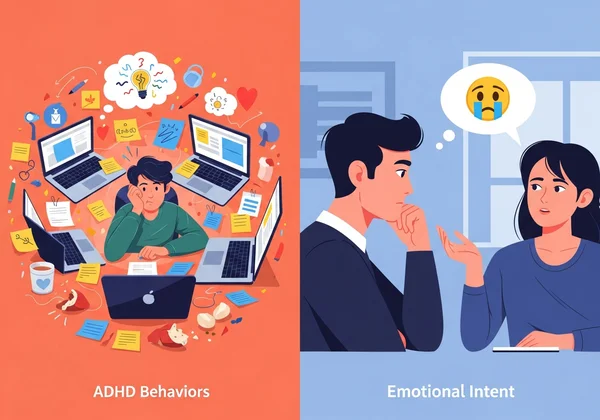
The Empathy Spectrum: Hyper-Empathy and Sensory Overload
While the media focuses on a "lack" of connection, many people experience ADHD and too much empathy. This is often referred to as hyper-empathy. If you find yourself crying during commercials or feeling physically ill when a co-worker is stressed, you are likely on this end of the spectrum.
Emotional Contagion: Feeling Other People's Pain
For some, the "emotional skin" is very thin. You absorb the moods of those around you like a sponge. If your partner is angry, you feel that anger in your own chest, even if it isn't directed at you. This makes social situations exhausting. You aren't just watching a movie or having a chat; you are riding an emotional rollercoaster that isn't even yours. This heightened sensitivity is a hallmark of many neurodivergent brains.
The Shutdown Response: When Empathy Becomes Overwhelming
When your brain is flooded with someone else's emotions, it may trigger a "system shutdown." This is a defense mechanism to prevent total burnout. To an outsider, you might look blank, distant, or even bored. Inside, your nervous system is screaming. You have reached your "empathy limit," and your brain has turned off the lights to prevent a meltdown. Detailed ADHD quiz results explained can often shed light on why these emotional spikes and sudden "flatness" happen so frequently.
Subtype Nuances: Inattentive vs. Hyperactive-Impulsive Patterns
Not all ADHD is the same, and neither is the way it interacts with your social life. Depending on your subtype, your empathy challenges may look very different.
Inattentive Type: Missing the Subtle "Between the Lines"
If you have the inattentive subtype, inattentive ADHD and empathy usually involves "missing the signal." You might be looking directly at someone but failing to register their sadness because your internal monologue is too loud. You are a kind person, but you are often "somewhere else." This subtype is most likely to be accused of being "daydreamy" or "disconnected," leading people to assume you don't care about their feelings.
Hyperactive-Impulsive Type: Reaction vs. Emotional Processing
For the hyperactive-impulsive type, the issue is often speed. You feel the empathy, but you react so quickly—perhaps with a joke or a quick "fix-it" solution—that you skip the crucial step of "sitting with" the person in their pain. You want to help, but your brain wants to move to the solution before the other person has finished expressing the problem. Learning to slow down is the key to demonstrating the empathy you truly feel.
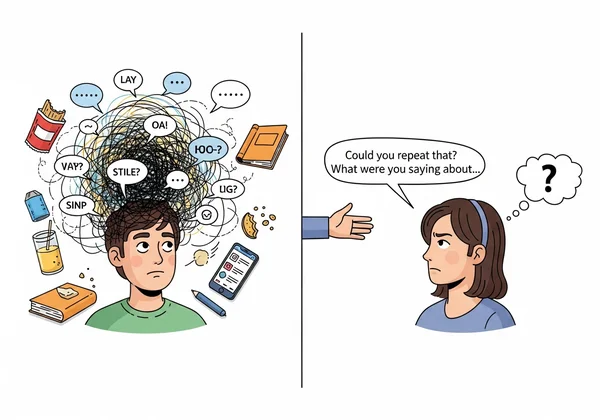
Mapping Your Traits: A Step Toward Better Connections
Awareness is the first step toward change. You cannot "fix" your brain, but you can build bridges. Once you understand that your struggles with ADHD and empathy are about processing, not personality, you can start being kinder to yourself. This self-compassion actually makes it easier to be empathetic toward others.
Using Self-Reflection to Improve Relationships
Start by observing your "misses." When a partner says you weren't listening, don't get defensive. Instead, ask yourself: "Where was my attention?" By identifying the "glitch" (like sensory overload or a wandering mind), you can explain it to your partner. You might say, "I really care about what you're saying, but the TV is making it hard for me to focus on your face. Can we move to a quiet room?" This transforms a moment of conflict into a moment of collaborative problem-solving.
Why the Adhdquiz Assessment is a Helpful Mirror
Sometimes, we are too close to our own lives to see the patterns clearly. Taking a structured moment for self-reflection can provide much-needed clarity. Using an educational tool can help you categorize your experiences and identify whether you lean toward hyper-empathy or cognitive processing delays. Our comprehensive ADHD quiz guide is designed to help you explore these traits in a safe, no-pressure environment. It isn't a medical diagnosis, but it is a powerful way to start a conversation with yourself—and eventually, with a professional or your loved ones.
Embracing Your Neurodivergent Heart
Living with ADHD and empathy challenges can feel like a lonely road. You might spend years wondering why you feel so much yet seem to get it "wrong" so often in social settings. Please remember: your brain is wired for intensity, and that includes intense caring.
By distinguishing between cognitive and affective empathy, you can stop blaming your character for what is actually a neurological process. You are not "broken" or "cold." You are simply navigating a world designed for neurotypical filters with a brain that lets everything in at once. With the right tools and a little bit of self-pity, you can turn your empathy into one of your greatest strengths.
Frequently Asked Questions
Why do I feel more empathy for animals than for people?
Many people with ADHD find animals easier to relate to because their emotional cues are simple, honest, and non-verbal. Animals don't use sarcasm, subtext, or complex social rules. This makes it much easier for the ADHD brain to process and respond to their needs without getting overwhelmed by the "social noise" that human interaction requires.
Is interrupting a sign that I don't care about others?
No, interrupting is usually a sign of impulsivity or a fear of losing a thought due to "working memory" issues. You might interrupt because you have a supportive thought and are afraid your brain will lose it if you don't say it immediately. It is an act of engagement, even if it feels like a dismissal to the other person.
Does having ADHD mean I have lower Emotional Intelligence (EQ)?
Not at all. Emotional Intelligence involves many factors, including self-awareness and social skills. While ADHD can make the regulation and expression of emotions difficult in the moment, it does not lower your capacity for deep feeling or understanding. Many neurodivergent people have exceptionally high EQ once they learn to navigate their unique sensory and attention triggers.
Can people with ADHD be "Empaths"?
Yes, many people with ADHD identify as empaths. The tendency to "absorb" the emotions of a room (emotional contagion) is very common in the ADHD community. This can be a beautiful gift, but it requires learning how to set emotional boundaries so you don't become chronically exhausted by the feelings of others.
How can I explain my empathy struggles to my partner?
Try using the "Attention vs. Intention" framework. Explain that you have the intention to care, but your attention is a limited resource that sometimes gets diverted by your brain's wiring. Asking for "patience and clear signals" is often more effective than simply apologizing for "not caring," as it addresses the root of the problem.