ADD vs. ADHD: What Is the Difference And Which Term Is Correct
You say ADD, your doctor says ADHD. If you are confused by the terminology, you are not alone. Many people still use "ADD" to describe trouble focusing without hyperactivity, while medical professionals have shifted almost entirely to "ADHD." This difference in language often leaves people wondering: Do I have a different condition? Is my diagnosis outdated?
The short answer is that ADD and ADHD are the same condition. However, the way we talk about them has evolved to better reflect how the brain works. Understanding this shift is the first step toward clarity.
In this guide, we will clear up the confusion between these terms. You will learn the three modern types of ADHD, how symptoms differ between the "inattentive" and "hyperactive" presentations, and why so many adults—especially women—go undiagnosed. Finally, we will help you spot the hidden signs and guide you on how to explore your own traits safely using our online adhd test.
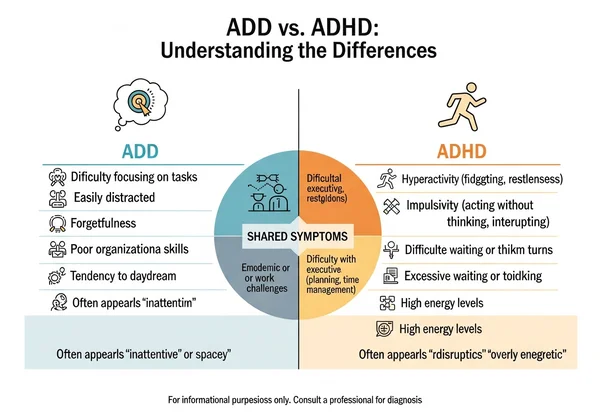
AI Image Prompt: A clean, minimalist infographic style illustration. A split screen or venn diagram concept. On the left side labeled "Old Term: ADD" showing a calm person daydreaming. On the right side labeled "Modern Term: ADHD" showing a spectrum with three colors. Soft medical blues and calming teals. High resolution, vector style. --ar 16:9
The Short Answer: Are ADD and ADHD the Same Thing
Yes, ADD and ADHD are technically the same condition. The term "ADD" (Attention Deficit Disorder) is no longer an official medical diagnosis. It has been replaced by the umbrella term ADHD (Attention Deficit Hyperactivity Disorder).
However, just because the name changed doesn't mean the "ADD" experience disappeared. What most people call ADD—being dreamy, forgetful, or disorganized without being hyper—is now clinically known as ADHD, Predominantly Inattentive Presentation.
This distinction is crucial. It means you can have ADHD without ever being hyperactive.
The Simple Definition: Yes, But Names Have Changed
Think of ADHD as the family name for a group of related brain traits. Within this family, there are different "personalities."
- Old Term: ADD (focused only on attention issues).
- New Term: Inattentive ADHD (acknowledges attention issues as part of the broader ADHD spectrum).
So, when you ask "what is the difference between add and adhd," the answer is mostly historical. They describe the same underlying neurodevelopmental difference, but "ADHD" is the current, medically accurate label that covers all types.
Why the Name Changed to ADHD (A Brief History)
For decades, the medical community struggled to name this condition accurately.
- In 1980, the DSM-III (the diagnostic manual used by doctors) actually called it "ADD" and allowed for a type without hyperactivity.
- In 1987, the name was changed to ADHD, which confused many people who didn't feel "hyper."
- In 1994 (and updated in DSM-5), the current system was solidified. It kept the name ADHD but clarified that you don't need to be hyperactive to be diagnosed.
This history explains why many adults who were diagnosed as children still say "ADD," while younger generations and doctors use "ADHD."
Visualizing the Spectrum: It's Not Two Boxes, It's a Scale
Instead of thinking of ADD and ADHD as two separate boxes, visualize a sliding scale or a spectrum.
On one end, you have pure inattention (daydreaming, losing things). On the other end, you have pure hyperactivity (can't sit still, impulsive). Most people fall somewhere in between or move along this scale throughout their lives. You aren't stuck in one box forever; your symptoms can shift as you age or as your environment changes.
One Condition, Three Presentations: Understanding the Types
To make things clearer, doctors now divide ADHD into three distinct "presentations." Knowing which one matches your experience is far more useful than worrying about the old ADD vs. ADHD labels.
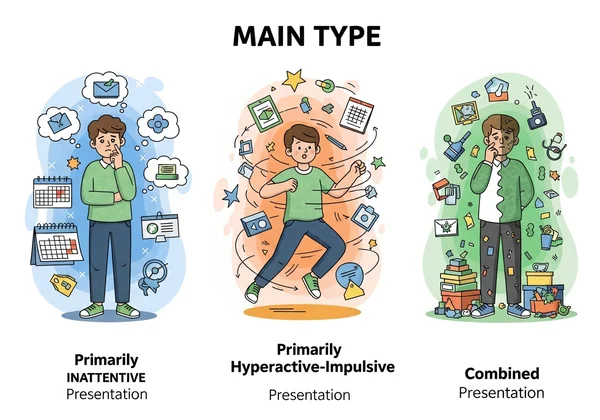
AI Image Prompt: An educational illustration showing three distinct brain profiles or character avatars. 1. "Inattentive" (looking at a butterfly/daydreaming). 2. "Hyperactive" (bouncing a ball/moving). 3. "Combined" (showing elements of both). Flat design, warm colors, approachable and non-clinical style. --ar 16:9
Inattentive Presentation (What We Used to Call ADD)
This is what most people mean when they say "ADD." People with this type are not bouncing off the walls. In fact, they often appear quiet, dreamy, or "spaced out."
Key traits include:
- Difficulty sustaining attention on boring tasks.
- Frequent careless mistakes or missing details.
- Trouble organizing tasks and activities.
- Losing daily items like keys, phones, or wallets.
- Forgetfulness in daily activities (like paying bills or returning calls).
Because these symptoms are not disruptive to others, this type is the most likely to go undiagnosed in childhood.
Hyperactive-Impulsive Presentation
This type fits the stereotypical image of "ADHD." It is more common in young boys and is much easier to spot because the behavior affects others.
Key traits include:
- Fidgeting, tapping hands, or squirming in seats.
- Running or climbing in inappropriate situations (or feeling restless as an adult).
- Talking excessively and interrupting others.
- Difficulty waiting for their turn.
- Acting on impulse without thinking of consequences.
Combined Presentation (Having Symptoms of Both)
This is actually the most common presentation. As the name suggests, people with this type exhibit roughly equal amounts of inattentive and hyperactive symptoms.
You might lose your keys every morning (inattentive) but also feel a constant inner motor that prevents you from relaxing (hyperactive). If you feel like you relate to both sides, you likely fall into this category.
ADD vs. ADHD Symptoms: How They Feel vs. How They Look
The biggest reason for the confusion between ADD and ADHD is that they feel very different from the inside, even if they share the same root causes. Let's break down the hidden struggle of the inattentive type.
The Internal Struggle: Symptoms You Can't See
For someone with Hyperactive ADHD, the struggle is external: I can't sit still. For someone with Inattentive ADHD (ADD), the struggle is internal: I can't direct my brain.
If you have the inattentive type, your mind might feel like a browser with 50 tabs open, and you don't know where the music is coming from. You might be sitting perfectly still in a meeting, but your brain has checked out completely. This "brain fog" or "drift" is invisible to teachers, bosses, and partners, which often leads to unfair labels like "lazy" or "unmotivated."
Comparing the Signs: Inattentive vs. Hyperactive
Here is a quick comparison to help you distinguish between the two main presentations.
| Feature | Inattentive (Formerly ADD) | Hyperactive-Impulsive |
|---|---|---|
| Energy Level | Often low, sluggish, or easily exhausted. | High energy, restless, "driven by a motor." |
| Social Behavior | May seem shy, withdrawn, or not listening. | Talkative, interrupts, intrudes on others. |
| Task Management | Procrastinates, loses focus, doesn't finish. | Rushes through, makes hasty mistakes. |
| Organization | Messy physical spaces, loses items. | Disorganized due to rushing, not forgetting. |
| Physical Movement | Can sit still but mind wanders. | Cannot sit still, needs to move. |
Quick Check: Do You Recognize These Inattentive Signs?
If you suspect you might have the inattentive type (ADD), ask yourself if these specific scenarios sound familiar. This is not a diagnosis, but a way to check your patterns.
- Do you often walk into a room and forget why you went there?
- Do you struggle to follow long conversations, drifting off even when you try to listen?
- Is your workspace or home constantly cluttered, despite your best efforts to clean?
- Do you avoid tasks that require sustained mental effort, like filling out forms or reading long reports?
- are you frequently late because you lost track of time ("time blindness")?
If you checked several of these boxes, your symptoms align closely with Inattentive ADHD. It might be helpful to explore this further with an online adhd test.
Why "ADD" Is Often Missed in Adults and Women
It is a common story: a woman in her 30s or 40s seeks help for anxiety, only to discover she has had Inattentive ADHD her whole life. Why does this happen so often?
The "Daydreamer" vs. The "Troublemaker" Bias
Schools and parents tend to notice behavior that causes trouble. The hyperactive boy disrupting the class gets sent to the school psychologist. The quiet girl staring out the window (the "daydreamer") is ignored because she isn't bothering anyone.
This bias means that people with Inattentive ADHD often fly under the radar until adulthood. They manage to scrape by in school, often by working twice as hard or relying on high intelligence to mask their struggles.
Masking: How Adults Hide Their Symptoms
By the time they reach adulthood, many people with undiagnosed ADD have developed coping mechanisms called "masking."
- Obsessive list-making to compensate for a bad memory.
- Extreme anxiety about time to avoid being late.
- Staying quiet in groups to avoid saying something "weird" or interrupting.
This masking takes a huge toll on energy and mental health. On the outside, you look like you are holding it together. On the inside, you are exhausted from the constant effort to function "normally."
Can Anxiety Be Mistaken for ADD?
Yes, frequently. The chronic stress of trying to keep up with life when you have untreated ADHD often looks like anxiety. You might be anxious because you are constantly forgetting things or missing deadlines. Treating the anxiety without addressing the underlying ADHD often fails to solve the root problem.
From Confusion to Clarity: The Next Steps
Now that you understand the difference between ADD and ADHD (and know they are the same condition), you might be wondering: Do I have it?

AI Image Prompt: A thoughtful woman sitting in a cozy, sunlit room, journaling or looking out a window. She looks reflective and peaceful, not stressed. Represents self-discovery and gaining clarity. Soft, natural lighting. Photographic style. --ar 16:9
Self-Reflection vs. Medical Diagnosis
It is important to distinguish between suspecting you have ADHD and getting a medical diagnosis. Only a qualified healthcare professional (like a psychiatrist or psychologist) can officially diagnose you.
However, a formal diagnosis process can be expensive and intimidating. Many people find it helpful to start with self-reflection. Understanding your own patterns is a valid and powerful first step. It gives you the language to describe your struggles and helps you decide if seeking professional help is the right move for you.
Take Our Free ADHD Insight Quiz
If the symptoms of Inattentive ADHD resonate with you, consider using a structured tool to clarify your thoughts.
We offer a specialized ADHD Insight Quiz designed to help you explore these traits in depth. It is not a diagnostic tool, but an educational resource that asks about common experiences related to focus, organization, and impulsivity.
Taking this quiz can help you:
- Identify specific patterns you may not have noticed.
- See how your symptoms compare to common ADHD profiles.
- Get a personalized report to help you understand your brain better.
It is free, confidential, and takes only a few minutes.
Start Your Free ADHD Assessment
How Is It Diagnosed Professionally
If your self-reflection or quiz results suggest a high likelihood of ADHD, you may choose to see a doctor. Here is what that process typically looks like.
What to Expect During a Medical Evaluation
There is no single blood test or brain scan for ADHD. A diagnosis is made based on a clinical interview and history.
- Clinical Interview: The doctor will ask about your childhood, school history, and current life.
- Symptom Checklists: You (and sometimes a partner or parent) will fill out standardized rating scales.
- Rule-Outs: They will check to ensure your symptoms aren't caused by sleep disorders, thyroid issues, or other mental health conditions.
Preparing for Your Doctor's Visit
To get the most out of an evaluation, come prepared. Write down examples of your symptoms in childhood and adulthood. Bring old report cards if you have them (comments like "potential not realized" or "daydreams often" are classic clues). Being honest about your daily struggles is the best way to help the doctor understand your reality.
Embracing Your Unique Brain
Whether you call it ADD or Inattentive ADHD, the label matters less than the understanding it brings. Realizing that your "laziness" or "forgetfulness" might actually be a difference in how your brain is wired can be incredibly liberating.
You are not broken; you just have a different operating system. Recognizing the signs is the first step toward finding strategies that work for you, rather than fighting against yourself. If you are ready to start that journey of discovery, our adhd test is here to help you take that first step.
Frequently Asked Questions
Is ADD hereditary or genetic?
Yes, ADHD (including the inattentive type formerly called ADD) is highly hereditary. If a parent has it, there is a significantly higher chance their child will also have it. It is common for adults to realize they have ADHD only after their child gets diagnosed.
Does Inattentive ADHD affect intelligence?
No, absolutely not. ADHD has nothing to do with intelligence. Many people with Inattentive ADHD are highly intelligent and creative. However, their symptoms can make it difficult to demonstrate their intelligence in traditional school or work settings without the right support.
Is ADD considered a learning disability?
Technically, no. ADHD is classified as a neurodevelopmental disorder, not a learning disability. However, it often co-occurs with learning disabilities like dyslexia. Even on its own, it can significantly impact learning by making it hard to focus, organize thoughts, or retain information.
Can ADD be cured?
ADHD is a lifelong condition, so it is not "cured" in the traditional sense. However, it can be effectively managed. Through medication, therapy, lifestyle changes, and proper accommodations, people with Inattentive ADHD can thrive and lead successful, fulfilling lives.