TDAH Test: What It Means and How to Use ADHD Screening Safely
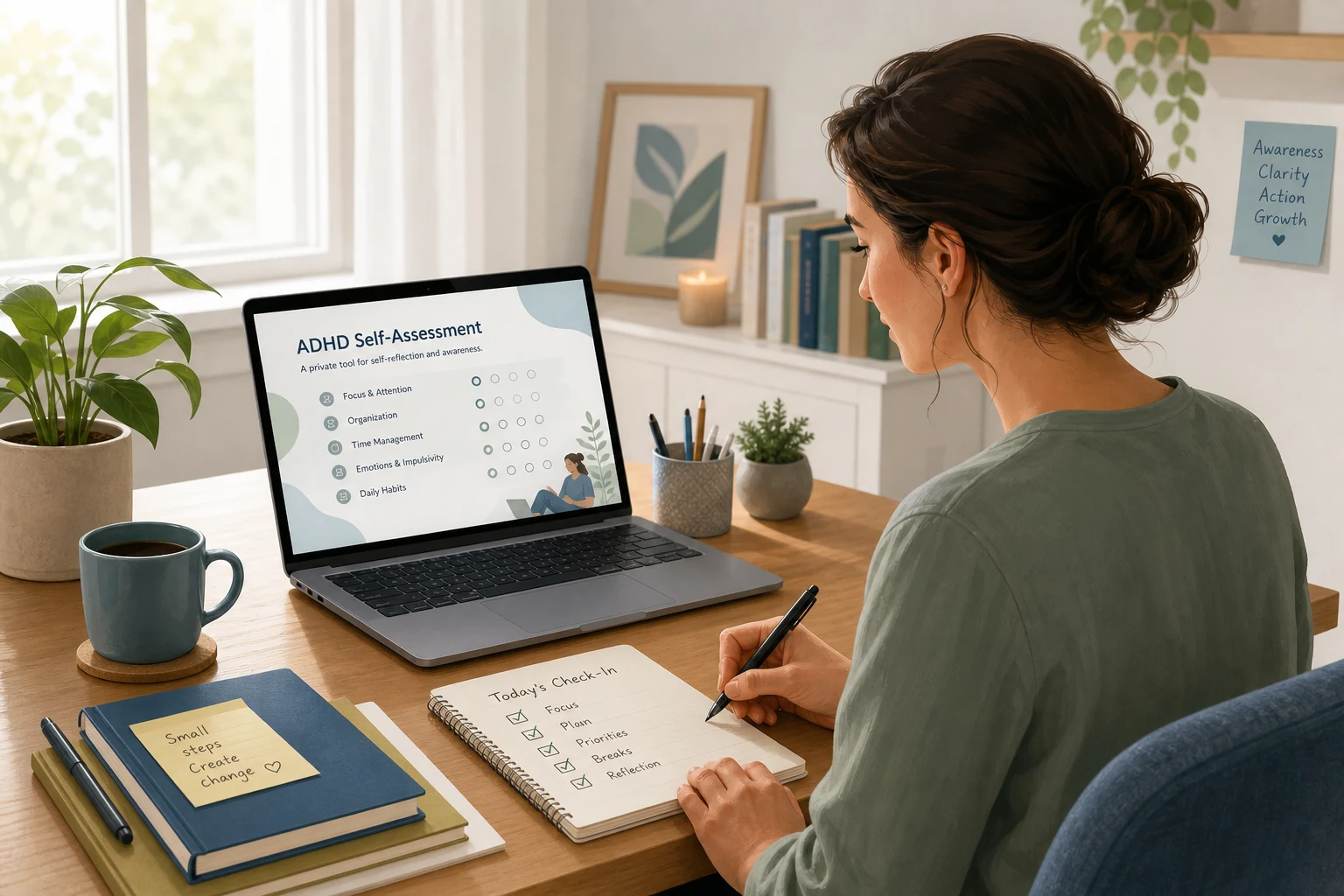
Searching for a tdah test often means you are trying to understand ADHD through another language lens. TDAH is the Spanish, Portuguese, and French abbreviation for attention-deficit/hyperactivity disorder, while ADHD is the common English abbreviation. The underlying topic is the same: patterns of attention, impulsivity, restlessness, organization, and daily functioning. An online screening can be a useful first step when you want structure before talking with a professional, but it is not a formal clinical evaluation. If you want a private place to organize your observations, a private ADHD self-assessment can help you reflect on common ADHD traits before deciding what support to explore next.
Are TDAH and ADHD the Same Thing?
In most everyday searches, yes. TDAH usually refers to the same condition called ADHD in English. The abbreviation changes because different languages place the words in a different order. Someone searching for test de tdah, teste de tdah, tdah test free, or tdah teste online may be looking for the same kind of screening information that English speakers call an ADHD test.
That does not mean every online quiz is the same quality. A helpful screening should ask about more than one vague feeling. It should cover patterns that tend to repeat across time, such as losing track of tasks, struggling to finish multi-step work, interrupting, feeling internally restless, avoiding long mental effort, or finding it hard to organize materials and time.
The best use of a tdah test is not to label yourself in a few minutes. It is to turn scattered memories into clearer notes. Those notes can help you decide whether your experiences are occasional stress, a pattern worth tracking, or something to discuss with a qualified clinician, counselor, school support team, or primary care provider.
What a TDAH Test Can and Cannot Tell You
A screening tool can help you notice whether your experiences resemble common ADHD patterns. It may ask how often certain behaviors happen, whether they interfere with school, work, home life, relationships, or self-care, and whether they have been present for a long time. This structure matters because ADHD is about persistent patterns, not a single bad week.
An online screening cannot replace a professional assessment. Many things can look like ADHD from the outside, including sleep problems, anxiety, depression, trauma, learning differences, substance use, major stress, or thyroid and hearing or vision concerns. For children and teens, school context and caregiver observations are especially important. For adults, history from childhood and examples from work, relationships, and home routines can help complete the picture.
Use an online ADHD quiz for structured reflection as a low-pressure way to collect signals, not as the final word. If the result feels relevant, the next step is usually to bring examples to someone who can review the wider context.
Signs People Usually Reflect On Before Testing
People do not usually search for a tdah test because of one isolated moment. They search because a pattern has started to feel hard to ignore. The pattern may look different depending on age, environment, personality, and support systems.
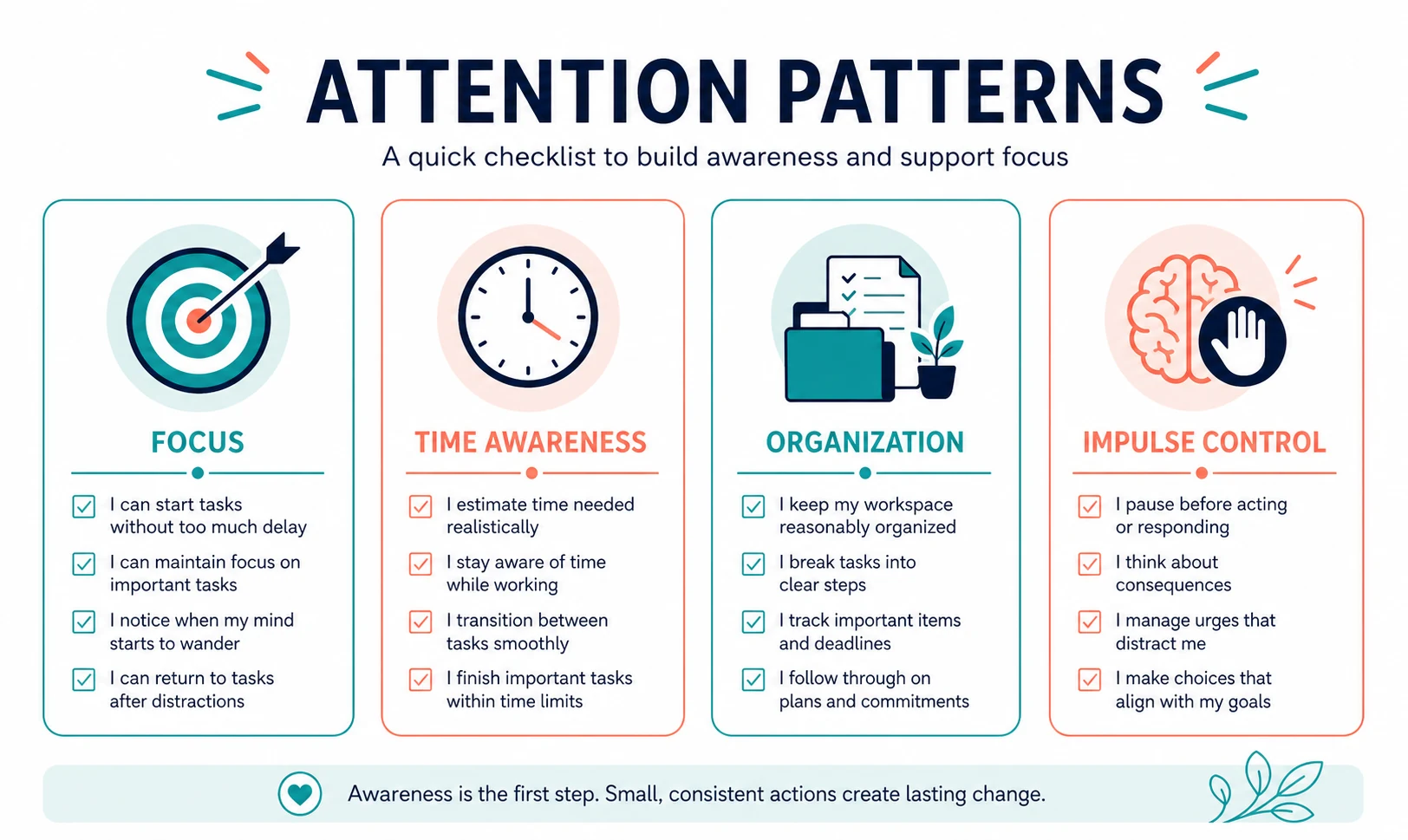
Common attention-related signs include losing details, rereading the same passage without absorbing it, starting tasks and drifting away, missing deadlines despite caring about the outcome, or needing intense pressure before beginning. Some people describe it as knowing what to do but not being able to make the first step happen at the right time.
Common hyperactivity or impulsivity signs may include restlessness, talking more than intended, interrupting, making fast decisions that later feel poorly timed, or feeling uncomfortable during quiet waiting. In adults, hyperactivity may feel internal rather than visible. A person may look calm while their mind feels noisy and hard to steer.
Children and teens may show these patterns through schoolwork, emotional outbursts, forgotten materials, difficulty following multi-step instructions, or conflict around routines. Adults may notice unfinished admin, time blindness, intense bursts of focus followed by exhaustion, clutter cycles, or a history of being called careless when they were actually trying hard.
How to Use a Free TDAH Test Without Over-Reading It
Free screening tools are appealing because they reduce friction. They can also create confusion if you treat the score as a complete answer. A healthier approach is to treat the result as one piece of a larger reflection.
Before you answer questions, think about your usual life over the past several months, not your worst day. ADHD-related patterns tend to show up repeatedly. If your answers are based only on a temporary crisis, exam week, grief, travel, or sleep loss, the result may reflect that pressure more than your long-term attention style.
As you answer, look for frequency, duration, and impact. Frequency asks how often the issue happens. Duration asks whether it has been around for a long time. Impact asks whether it affects responsibilities, relationships, health, learning, money, driving, or emotional well-being. These three lenses are more useful than asking, "Do I relate to this symptom?"
After the result, write down three to five examples. Choose specific moments: a missed bill, a late assignment, an unfinished report, a forgotten appointment, a risky impulse buy, or a conflict caused by interrupting. Specific examples are easier to discuss than a general feeling of being overwhelmed.

Adult TDAH Tests Versus Child and Teen Screening
Adult searches often include phrases like test tdah adultos, tdah en adultos test, or tdah test para adultos. Adult screening should pay attention to current life, but it should also consider long-standing patterns. Many adults first recognize ADHD after years of coping, masking, or being seen as inconsistent rather than unsupported.
Adult examples may include difficulty prioritizing, losing time in small tasks, forgetting obligations, struggling with paperwork, emotional reactivity, or relying on deadlines to create urgency. Some adults perform well externally but spend far more effort than others to keep routines together.
For children and teens, a screening is usually strongest when it includes adult observation. A parent may notice problems at home, while teachers may see a different pattern at school. Coaches, tutors, or caregivers can also provide useful context. Because children develop at different speeds, the question is not whether a child is sometimes energetic or distracted. The more useful question is whether the pattern is frequent, out of step with age expectations, and disruptive across settings.
For both groups, screening works best when it leads to conversation. Adults can bring notes to a clinician or counselor. Parents can bring observations to a pediatrician, school psychologist, or other qualified support professional.
TDAH, Autism, Anxiety, and Other Look-Alikes
One People Also Ask question is whether TDAH is autism. No, ADHD and autism are different neurodevelopmental profiles, although some people have traits of both. They can also overlap in visible ways. For example, difficulty with transitions, sensory overload, intense interests, social friction, or executive function challenges may lead someone to compare the two.
Anxiety can also resemble ADHD. A worried person may appear distracted because their attention is caught by fear or rumination. Depression can slow motivation and memory. Sleep problems can make focus and impulse control much harder. Learning differences can lead to avoidance or classroom disruption when the work feels inaccessible.
This is why a screening result should be handled with care. It can point you toward useful questions, but it cannot sort every possible explanation by itself. If several areas of life are affected, a broader assessment can look at attention, mood, sleep, learning, medical history, and daily environment together.
What to Do After a TDAH Test Result
The most useful next step is not panic; it is organization. Save or write down your result, the date, and the situations that made you search in the first place. Then add examples from more than one setting if possible: work and home, school and family life, social plans and personal routines.
You can also rate which issues are most disruptive. Is the biggest problem missed deadlines, emotional outbursts, forgotten tasks, impulsive spending, school conflict, driving risk, or chronic exhaustion from overcompensating? Ranking the impact helps you decide what support would actually improve daily life.
If you are not ready for a professional conversation yet, try one small support experiment for two weeks. Use one visible task list, set reminders where you actually look, break one recurring task into smaller steps, or ask a trusted person to help you compare plans with reality. The point is not to prove anything. The point is to see whether structure reduces friction.
When you are ready, an ADHD screening starting point can help you organize what you have noticed before a clinical conversation. Bring your examples, questions, and any school, work, or health history that feels relevant.

A Safer Way to Think About Your TDAH Test
A tdah test is most helpful when it gives you language, not certainty. It can help you notice patterns in attention, restlessness, impulsivity, time management, and follow-through. It can also help you explain those patterns without shame: "Here is what I keep noticing, here is where it affects my life, and here is what I want to understand better."
If your result feels strongly familiar, treat that as a reason to gather better information. If it does not fit, but your daily life still feels difficult, that matters too. ADHD is only one possible explanation for attention and organization struggles. You still deserve support for the problem you are actually living with.
For many people, the value of a screening is that it turns a private worry into a clearer next question. You can review a confidential ADHD reflection tool, compare the result with your real-life examples, and decide whether to seek a fuller professional review, school support, workplace accommodation conversation, or practical daily strategies.
FAQ
Are TDAH and ADHD the same thing?
Usually, yes. TDAH is the abbreviation used in languages such as Spanish, Portuguese, and French, while ADHD is the common English abbreviation. The words appear in a different order, but the topic is generally the same.
How can I know if I have TDAH?
You can start by tracking repeated patterns in attention, impulsivity, restlessness, organization, and daily impact. An online screening can help organize those observations, but a qualified professional is needed for a formal clinical answer.
Is TDAH autism?
No. ADHD and autism are different neurodevelopmental profiles. Some people have both, and some visible traits can overlap, so a broader assessment may be useful when the picture is unclear.
Is TDAH a disability?
It can be, depending on the person, the level of impairment, and the laws or support systems in a country, school, or workplace. Many people with ADHD function well with the right strategies, while others need formal accommodations.
Is a free TDAH test reliable?
A free screening can be useful if it asks clear questions about frequency, duration, and real-life impact. It should be treated as an educational starting point, not a final clinical answer.
What should I do after a high TDAH test score?
Write down your result, list specific examples, and consider discussing them with a qualified professional. If the concerns involve a child or teen, gather observations from more than one setting when possible.
Can adults use a TDAH test?
Yes. Adults often use screening to reflect on long-standing patterns in focus, time management, impulsivity, and organization. Adult context matters, especially whether similar patterns were present earlier in life.