DSM-5 Criteria for Attention Deficit Disorder (ADHD)
Whether you are a parent observing your child's behavior or an adult reflecting on lifelong struggles with focus and organization, navigating the diagnostic landscape of Attention Deficit Hyperactivity Disorder (ADHD) can feel overwhelming. The Diagnostic and Statistical Manual of Mental Disorders, Fifth Edition (DSM-5), serves as the official guide for clinicians to identify ADHD. Understanding these standardized criteria can provide clarity on what behaviors are considered clinically significant versus typical daily challenges. In this comprehensive guide, we will break down the exact dsm v attention deficit disorder criteria, explain the differences between adult and childhood presentations, and provide a clear framework for safely exploring your own attention patterns. If you are curious about your traits, you can naturally explore our Adhdquiz.net online test to gain initial insights.

What Are the Core DSM-5 Criteria for ADHD?
The DSM-5 diagnostic criteria for attention deficit hyperactivity disorder are split into two primary categories. To be diagnosed, a person must show a persistent pattern of these symptoms that negatively impacts their daily life.
The 9 Symptoms of Inattention
Inattention symptoms in the DSM-5 reflect a chronic difficulty in sustaining focus and staying organized. The manual lists nine specific traits:
- Often fails to give close attention to details or makes careless mistakes.
- Often has difficulty sustaining attention in tasks or play activities.
- Often does not seem to listen when spoken to directly.
- Often fails to follow through on instructions and finish complete tasks.
- Often has difficulty organizing tasks and activities.
- Often avoids or dislikes tasks requiring sustained mental effort.
- Often loses things necessary for daily tasks.
- Is often easily distracted by extraneous stimuli.
- Is often forgetful in daily activities.
The 9 Symptoms of Hyperactivity and Impulsivity
Hyperactivity and impulsivity relate to excessive movement and hasty actions. The nine symptoms include:
- Often fidgets with or taps hands or feet.
- Often leaves a seat when remaining seated is expected.
- Often runs about or climbs in situations where it is inappropriate.
- Often is unable to play or engage in leisure activities quietly.
- Is often "on the go," acting as if "driven by a motor."
- Often talks excessively.
- Often blurts out an answer before a question has been completed.
- Often has trouble waiting their turn.
- Often interrupts or intrudes on others.
How ADHD Presentations Differ (The 3 Types)
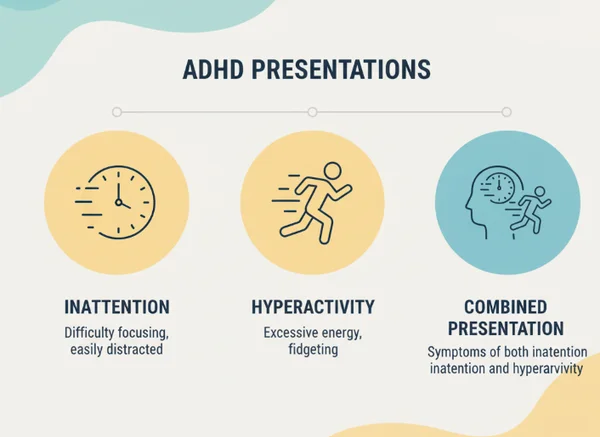
The DSM-5 no longer views attention deficit disorder (ADD) as a separate condition. Instead, it classifies ADHD into three specific types or "presentations" based on which symptoms are most dominant.
Predominantly Inattentive Presentation
If you meet the criteria for inattention but not hyperactivity, you might have the predominantly inattentive presentation. This was formerly known as ADD. People with this presentation might not act disruptive. Consequently, their struggles can sometimes go unnoticed for years.
Predominantly Hyperactive-Impulsive Presentation
This presentation occurs when hyperactivity and impulsivity symptoms are dominant. These individuals may struggle to sit still, act impulsively, or interrupt others frequently. It is less common to have this presentation without any inattention symptoms.
Combined Presentation
The combined presentation adhd occurs when a person exhibits enough symptoms of both inattention and hyperactivity-impulsivity. This is the most frequently diagnosed presentation. Remember, these presentations are not fixed. A person's presentation can change over their lifespan as they age.
Special Considerations for Adults vs. Children
The dsm 5 adhd criteria in adults differs slightly from the criteria for children. This adjustment reflects how symptoms naturally evolve as the brain matures and environments change.
Symptom Threshold Differences (5 vs. 6)
For children strictly up to age 16, the DSM-5 requires at least six symptoms in either category to consider a diagnosis. However, for older adolescents and adults (age 17 and older), the threshold is lower. Adults only need to exhibit five symptoms. Why? Because ADHD traits often become more internalized as we grow up.
How Symptoms Manifest in Daily Adult Life
In adults, the criteria look different in practice. For example, "running and climbing" might transform into a persistent feeling of inner restlessness. "Failing to finish schoolwork" might look like jumping between multiple uncompleted projects at the office. You may find yourself frequently losing your keys or struggling to prioritize emails.
Important Diagnostic Conditions Beyond Symptoms
The presence of traits is only one part of the dsm v attention deficit disorder criteria. Clinicians must also ensure that several other strict conditions are met before making a diagnosis.
Onset Before Age 12 and Symptom Duration
Symptoms must have been present prior to the age of 12. ADHD is considered a neurodevelopmental disorder, meaning it begins in childhood. Furthermore, the symptoms must have persisted consistently for at least six months.
Presence in Multiple Settings
The traits cannot only happen at home or only at the office. The DSM-5 requires that symptoms be present in two or more settings. You might struggle both at school and during extracurricular activities, or at work and in your relationships.
Significant Impairment in Daily Functioning
There must be clear evidence that the symptoms interfere with your quality of life. This means the traits genuinely disrupt your social, academic, or occupational functioning. We all forget things sometimes, but for an ADHD diagnosis, the forgetfulness must cause tangible, chronic problems.
Next Steps: Safely Exploring Your Symptoms
Reading through the DSM-5 criteria can bring a lot of emotions to the surface. It is completely normal to feel a mix of validation and confusion. If these traits resonate with you, taking time to reflect is a healthy next step.
Why Self-Reflection is a Valuable First Step
Before rushing to make an appointment, organizing your thoughts can be incredibly beneficial. Self-reflection helps you articulate exactly how these symptoms affect your daily life. It gives you a structured way to look at your past and present behavior without pressure.
Try Our Online ADHD Screener
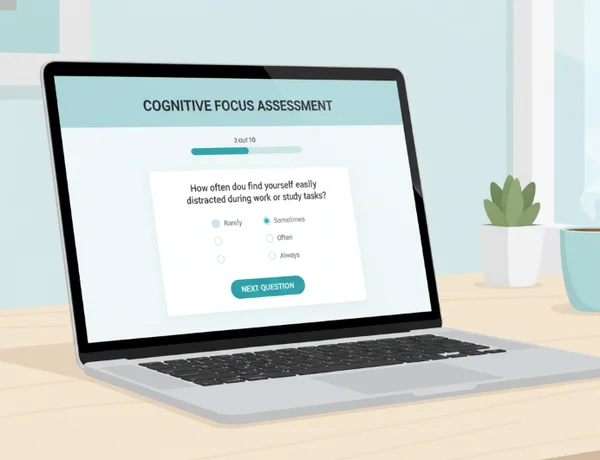
If you want a clearer picture of your attention traits, you might find it helpful to try the Adhdquiz.net online screener. This tool translates standard clinical criteria into simple, relatable questions. It is a completely free, fast way to evaluate your experiences safely.
Understanding the Limits of Self-Assessment
It is crucial to understand the boundaries of any online tool. Checklists and quizzes cannot diagnose you. They cannot replace a professional medical assessment. They are strictly educational resources designed to give you initial insights and help you decide whether to consult a healthcare provider.
Moving Forward with Clarity
Understanding the dsm v attention deficit disorder criteria is an empowering first step toward clarity. Whether you relate to the predominantly inattentive side or the hyperactive side, recognizing these patterns can help you seek the right support. Remember, only a qualified healthcare professional can formally diagnose you and offer a treatment plan. However, you can actively start exploring your focus patterns today to gather the insights you need for your journey.
Frequently Asked Questions
Is attention deficit disorder (ADD) still a valid diagnosis in the DSM-5?
No, ADD is an outdated term. The DSM-5 now classifies it as "ADHD, predominantly inattentive presentation," acknowledging that hyperactivity is not required for the diagnosis.
How do you formally diagnose ADHD based on the DSM-5?
You cannot diagnose yourself. A qualified healthcare professional, such as a psychiatrist or psychologist, must conduct a comprehensive clinical interview and evaluation based on the official guidelines.
What signs might prompt someone to seek a professional ADHD evaluation?
If your struggles with focus, organization, or impulsivity consistently cause significant problems at work, school, or in your relationships, it may be time to consult a doctor.
Can a person's ADHD presentation type change over time?
Yes. Research shows that as you mature, overt hyperactivity often lessens and turns into inner restlessness, meaning your presentation might change from combined to predominantly inattentive.
Can anxiety or depression mimic DSM-5 ADHD symptoms?
Yes. Both anxiety and depression can cause severe difficulty concentrating and restlessness. This is why a professional must rule out other conditions during the diagnostic evaluation.