DSM-5 ADHD Criteria – A Complete Guide for Adults and Parents
If you have ever wondered whether certain patterns of distraction, restlessness, or impulsivity might point to ADHD, the DSM-5 ADHD criteria offer a structured starting point. The Diagnostic and Statistical Manual of Mental Disorders, Fifth Edition, is the framework clinicians rely on to evaluate attention-deficit/hyperactivity disorder across all age groups. However, understanding what those criteria actually say — and how they apply differently to adults and children — can feel overwhelming when you first encounter them.
This guide breaks down every element of the DSM-5 criteria for ADHD in plain language. You will learn the specific symptom lists, the three recognized presentations, what changes for adults, and what steps typically follow a screening. If you want to organize your thoughts before a conversation with a professional, you may also find it helpful to explore the ADHD quiz at Adhdquiz.net as a confidential self-reflection tool.
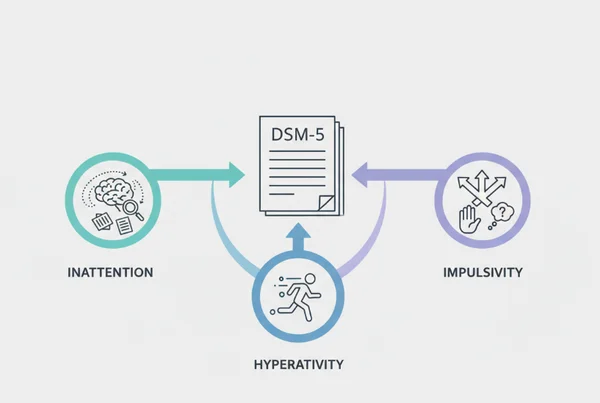
What Is the DSM-5 and Why Does It Matter for ADHD?
The DSM-5 is published by the American Psychiatric Association. It serves as the primary reference guide for mental health professionals in the United States and many other countries. When a clinician evaluates someone for ADHD, they compare observed behaviors and reported experiences against the specific criteria listed in this manual.
Why does this matter to you? Because the DSM-5 criteria for ADHD are not just a clinical checklist — they shape how ADHD is understood, discussed, and treated worldwide. Knowing what they include helps you:
- Recognize which patterns are clinically relevant versus everyday struggles
- Prepare for a professional evaluation with clearer self-awareness
- Understand the language your doctor or therapist may use
The DSM-5 replaced the DSM-IV-TR in 2013. Key updates for ADHD included raising the age-of-onset requirement from 7 to 12 years and reducing the symptom threshold for adults from six to five symptoms. These changes acknowledged that ADHD often persists into adulthood and may look different than it does in childhood.
What Are the DSM-5 Inattention Symptoms?
The first symptom domain in the ADHD diagnostic criteria DSM-5 is inattention. To meet this threshold, a person under 17 must show at least six of the following symptoms. Adults aged 17 and older need at least five. In every case, symptoms must persist for at least six months and be inconsistent with the person's developmental level.
Here are the nine inattention symptoms listed in the DSM-5:
- Careless mistakes — Often fails to give close attention to details or makes errors in schoolwork, job tasks, or other activities.
- Difficulty sustaining attention — Struggles to stay focused during tasks, lectures, conversations, or lengthy reading.
- Seems not to listen — Appears mentally elsewhere when spoken to directly, even without an obvious distraction.
- Fails to follow through — Starts tasks but loses focus and gets sidetracked before finishing schoolwork, chores, or workplace duties.
- Difficulty organizing — Struggles with managing sequential tasks, keeping materials in order, or meeting deadlines.
- Avoids sustained mental effort — Dislikes or is reluctant to engage in tasks that require prolonged concentration, such as reports or forms.
- Loses necessary items — Frequently misplaces keys, wallets, phones, paperwork, glasses, or tools needed for daily tasks.
- Easily distracted — Attention is pulled away by unrelated thoughts or stimuli that others might filter out.
- Forgetful in daily activities — Forgets appointments, returning calls, paying bills, or completing routine responsibilities.
These symptoms must cause real problems in daily life — not just occasional absentmindedness that everyone experiences from time to time.

What Are the DSM-5 Hyperactivity-Impulsivity Symptoms?
The second symptom domain covers hyperactivity and impulsivity. The same thresholds apply — six symptoms for those under 17, five for adults 17 and older — lasting at least six months.
Here are the nine hyperactivity-impulsivity symptoms:
- Fidgets or squirms — Often taps hands or feet or shifts position restlessly while seated.
- Leaves seat inappropriately — Gets up in situations where staying seated is expected, such as meetings or classrooms.
- Runs or climbs inappropriately — In children, this is literal. In adolescents and adults, it may present as a persistent feeling of restlessness.
- Cannot engage in activities quietly — Has difficulty playing or working without generating noticeable noise or movement.
- Always "on the go" — Acts as if driven by a motor; feels uncomfortable being still for extended periods.
- Talks excessively — Speaks more than the social situation calls for, often without noticing.
- Blurts out answers — Responds before a question is fully asked or finishes other people's sentences.
- Difficulty waiting turns — Struggles with waiting in line, during conversations, or in group activities.
- Interrupts or intrudes — Cuts into conversations, games, or activities without invitation; may start using others' things without asking.
For adults, hyperactivity often shifts from outward physical movement to an internal sense of restlessness, racing thoughts, or difficulty relaxing. This is one reason why adult ADHD can be harder to spot.
Three ADHD Presentations Recognized by the DSM-5
The DSM-5 does not describe ADHD as a single condition with identical features in every person. Instead, it identifies three presentations based on which symptom domain is most prominent:
| Presentation | Requirement | Common Signs |
|---|---|---|
| Predominantly Inattentive | Meets inattention threshold but not hyperactivity-impulsivity | Daydreaming, disorganization, quiet underperformance |
| Predominantly Hyperactive-Impulsive | Meets hyperactivity-impulsivity threshold but not inattention | Restlessness, interrupting, difficulty waiting |
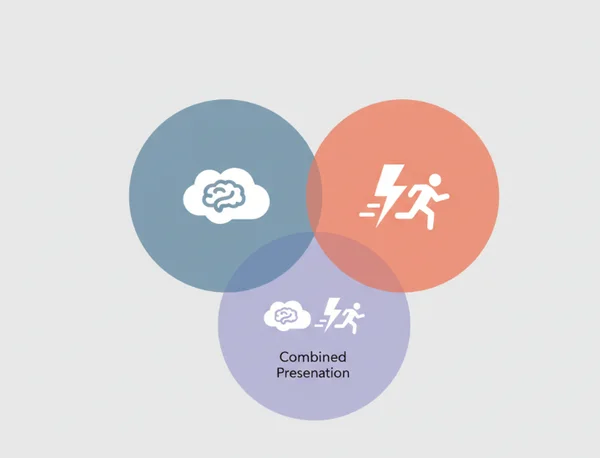
| Combined | Meets thresholds in both domains | Mix of focus difficulties and hyperactive-impulsive behaviors |
A few important points about these presentations:
-
Your presentation can change over time. A child diagnosed with the combined type may show predominantly inattentive features as an adult.
-
The predominantly inattentive presentation is often underdiagnosed, especially in women and girls, because it lacks the visible restlessness that typically prompts evaluation.
-
No single presentation is "more serious" than another. Each can significantly affect daily functioning.
How Do DSM-5 Criteria for ADHD in Adults Differ From Children?
While the core symptom lists are the same for all ages, the DSM-5 criteria for ADHD in adults include several important adjustments:
- Lower symptom threshold. Adults 17 and older need five symptoms in a domain rather than six. This reflects the understanding that symptoms often become subtler with age.
- Age of onset shifted to 12. Several symptoms must have been present before age 12 — not necessarily a full diagnosis, but evidence of early patterns.
- Symptom expression changes. Hyperactivity in adults more commonly appears as inner restlessness, excessive mental activity, or difficulty unwinding rather than running or climbing.
- Functional impact across settings. Symptoms must be present in two or more settings, such as work and home. For adults, this might include relationships, finances, or parenting.
Many adults seeking an ADHD evaluation were never assessed in childhood. Some developed coping strategies that masked their symptoms for years. Others were misdiagnosed with anxiety or depression. The DSM-5 acknowledges this reality by focusing on lifetime patterns rather than requiring a childhood diagnosis.
What Makes Adult ADHD Evaluation Challenging?
Several factors can complicate the process:
- Overlap with other conditions. Anxiety, depression, and sleep disorders can mimic or coexist with ADHD symptoms.
- Reliance on self-report. Adults must recall childhood behaviors, which can be difficult or inaccurate without supporting evidence from family members or school records.
- Compensation and masking. High intelligence or strong external structure can hide ADHD traits, leading to late recognition.
If you recognize some of these patterns in yourself, a structured self-reflection can help you organize your observations before seeing a professional. You might consider trying the ADHD self-assessment at Adhdquiz.net to identify areas worth discussing with a clinician.
Beyond Symptoms — Additional DSM-5 Requirements for an ADHD Diagnosis
Meeting the symptom count alone is not enough for a diagnosis. The DSM-5 sets several additional conditions that must all be satisfied:
- Duration. Symptoms must persist for at least six months.
- Age of onset. Several inattentive or hyperactive-impulsive symptoms must have been present before age 12.
- Cross-setting evidence. Symptoms must appear in two or more environments — for example, at school and at home, or at work and in relationships.
- Functional impairment. There must be clear evidence that symptoms interfere with or reduce the quality of social, academic, or occupational functioning.
- Differential diagnosis. Symptoms must not be better explained by another mental health condition, such as an anxiety disorder, mood disorder, personality disorder, or substance use.
This multi-layered approach exists to prevent both overdiagnosis and underdiagnosis. A proper ADHD evaluation typically involves clinical interviews, behavioral rating scales, developmental history, and sometimes neuropsychological testing.
A Quick Self-Check Before Seeing a Professional
Before your appointment, consider reflecting on the following:
- Do you notice these patterns across different areas of your life, not just one stressful situation?
- Have friends, partners, or family members commented on similar behaviors over the years?
- Did any of these tendencies show up in childhood, even if they were not identified as ADHD?
- Have you tried organizational strategies that consistently fall short despite your best efforts?
Writing down specific examples can make your conversation with a clinician more productive. These observations are not a diagnosis — they are a starting point for a professional evaluation.
When to Consider a Professional ADHD Evaluation
Understanding the DSM-5 ADHD criteria is valuable, but reading about symptoms is not the same as receiving a clinical assessment. Consider reaching out to a qualified professional if:
- Your symptoms have persisted for months or years, not just during a stressful period
- Daily tasks at work, school, or home feel consistently harder than they should
- Relationships are affected by forgetfulness, impulsivity, or emotional reactivity
- You have tried common organizational tools and strategies without lasting improvement
- You suspect that anxiety or mood difficulties may be connected to underlying attention issues
A professional evaluation provides clarity, context, and — when appropriate — access to evidence-based support strategies. Whether the outcome confirms ADHD or points in a different direction, the process itself is worthwhile.
This article is for educational purposes only and does not constitute a medical diagnosis. If you suspect you or your child may have ADHD, please consult a licensed healthcare professional for a comprehensive evaluation.
If you want to begin organizing your thoughts, take the free ADHD quiz at Adhdquiz.net as a first step toward understanding your patterns better.
Frequently Asked Questions
What are the DSM-5 criteria for ADHD?
The DSM-5 requires a persistent pattern of inattention and/or hyperactivity-impulsivity across at least two settings, with symptoms present before age 12 and lasting at least six months. Adults need five symptoms in a domain; those under 17 need six.
How many symptoms are needed for an ADHD diagnosis in adults?
Adults aged 17 and older must demonstrate at least five symptoms from either the inattention domain or the hyperactivity-impulsivity domain. For those under 17, the threshold is six symptoms per domain.
Can you have ADHD without hyperactivity?
Yes. The predominantly inattentive presentation of ADHD does not require hyperactive or impulsive symptoms. A person can meet the full diagnostic criteria through inattention symptoms alone, which is especially common in women and older adults.
What are the three types of ADHD in the DSM-5?
The DSM-5 identifies three presentations: predominantly inattentive, predominantly hyperactive-impulsive, and combined. Your presentation depends on which symptom domains meet the threshold and may change over time.
What is the difference between DSM-5 and DSM-5-TR for ADHD?
The DSM-5-TR (Text Revision, 2022) made minor text clarifications to the ADHD section but did not change the core diagnostic criteria. The symptom lists, thresholds, and additional requirements remain the same as the original DSM-5.
What is the gold standard for diagnosing ADHD?
A comprehensive clinical evaluation is considered the gold standard. This typically includes a detailed clinical interview, behavioral rating scales, developmental history review, and ruling out other conditions. No single test or quiz can diagnose ADHD on its own.