ADHD Causes Explained by Risk Factors, Brain Development, and Myths
When people search for ADHD causes, they are often looking for a clean answer: was it genetics, parenting, trauma, screens, food, or something in the brain? The honest answer is more layered. ADHD is best understood as a neurodevelopmental condition shaped by inherited risk, brain development, early-life exposures, and the demands of a person's environment. It is not a character flaw, a simple habit problem, or proof that someone was raised the wrong way. If you are trying to organize your own observations before talking with a professional, a confidential ADHD self-reflection tool can be a gentle first step.

What Are the Main Causes of ADHD?
There is no single cause of ADHD that explains every person's experience. Research points to a combination of factors that can raise the likelihood of ADHD traits. Genetics are a major part of the picture, which is why ADHD often runs in families. Brain development and brain activity patterns also matter, especially in systems involved in attention, impulse control, planning, reward, and emotional regulation.
Early-life factors may add risk for some people. These can include premature birth, significant head injury, prenatal alcohol or nicotine exposure, lead exposure, and other pregnancy or early childhood health factors. A risk factor is not the same as a certain outcome. Many children with one risk factor do not develop ADHD, and many people with ADHD do not have a clear single event that explains it.
It helps to think of ADHD causes as a risk pattern rather than a blame trail. For most people, ADHD appears when biology and development interact over time. The environment can make symptoms easier or harder to manage, but everyday parenting choices, normal screen use, sugar, or being "lazy" are not considered root causes.
What Causes ADHD in the Brain?
The phrase "what causes ADHD in the brain" can sound as if there should be one visible brain difference. In real life, ADHD is more complex. Studies have explored brain networks involved in executive function, including areas that support attention, working memory, self-control, motivation, and task switching. Researchers have also studied dopamine and norepinephrine systems because these chemical messengers are involved in attention and reward.
That does not mean a brain scan can neatly identify ADHD for one person. ADHD is usually understood through patterns of behavior across settings, history, impairment, and professional evaluation. Brain research helps explain why ADHD can affect focus, impulse control, time awareness, emotional regulation, and follow-through, but it does not turn the condition into a simple lab result.
One practical takeaway is that ADHD is not merely a refusal to try. A person may care deeply and still struggle to start, organize, pause, prioritize, or finish, especially when a task is boring, delayed, unclear, or emotionally loaded.

ADHD Causes in Children
ADHD often becomes noticeable in childhood because school, family routines, friendships, and safety rules all demand sustained attention and self-control. For children, inherited risk is a strong factor. If a parent or sibling has ADHD traits, a child may be more likely to show similar patterns.
Early development can also matter. Prematurity, prenatal exposure to alcohol or nicotine, significant head injury, and some environmental exposures have been studied as possible risk factors. These do not automatically lead to ADHD, but they are part of the research picture.
Parents often ask whether a 4-year-old can be evaluated for ADHD. A 4-year-old can be assessed by a qualified professional, but preschool behavior needs special care because high energy, short attention span, and impulsive moments can also be typical at that age. The key question is whether behaviors are persistent, developmentally unusual, present in more than one setting, and causing real difficulty.
For families, the most useful next step is usually structured observation. Write down what happens, where it happens, how often it happens, what seems to help, and what makes it harder. A parent-facing ADHD screening starting point may help organize those observations, but it should not replace a pediatric or mental health evaluation when concerns are significant.
What Causes ADHD in Adults?
ADHD in adults is usually not a brand-new condition that appears out of nowhere. Many adults looking into ADHD causes are recognizing long-standing patterns that became harder to compensate for after school, career changes, parenting, burnout, relationship demands, or independent living increased the load.
Adult ADHD can be missed earlier when support systems, intelligence, strict routines, or intense interests mask the difficulty. Others are simply seen as dreamy, inconsistent, anxious, messy, emotional, or underachieving. Women and people with primarily inattentive traits can be especially easy to overlook.
Anxiety, depression, sleep problems, trauma history, substance use, thyroid issues, and learning differences can overlap with ADHD-like symptoms or exist alongside ADHD. This is why an adult exploring ADHD should also consider sleep, stress, mood, medical history, and life context.
The adult causes question is often really a timing question: "Why is this showing up now?" Often, the traits were already there, but the environment changed. A less structured job, parenting, remote work, grief, stress, or sleep disruption can make old patterns more visible.

Psychological Causes of ADHD and Trauma Questions
"Psychological causes of ADHD" is a common search, but the wording can be misleading. ADHD is not considered a condition created simply by attitude, motivation, personality, or parenting style. It is rooted in neurodevelopment, with genetics and biology playing a major role.
Trauma, chronic stress, anxiety, depression, and PTSD can affect attention, memory, sleep, emotional control, and impulse regulation. Those effects can look similar to ADHD from the outside. Trauma can also coexist with ADHD, and the two may intensify each other. A person with ADHD may be more vulnerable to criticism, accidents, academic struggle, conflict, or shame, while traumatic stress can make focus and emotional regulation harder.
So, can trauma cause ADHD? It is safer to say trauma can produce ADHD-like difficulties and may interact with existing vulnerabilities. It should be taken seriously, but it should not be used as a simple replacement explanation for every ADHD pattern. A careful professional history can help separate long-standing neurodevelopmental traits from stress-related symptoms and can identify where both are present.
What Does Not Cause ADHD?
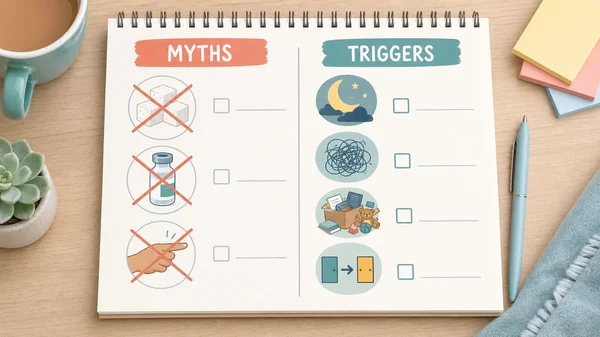
Some myths are sticky because they offer simple answers. Current major pediatric and public health sources do not support the idea that ADHD is caused by too much sugar, vaccines, allergies, ordinary parenting mistakes, or a child choosing to be difficult.
Food dyes and additives are more complicated in everyday conversation. Some families notice behavior changes after certain foods, but food dye is not considered a root cause of ADHD. Food tracking should stay calm and practical, not fear-based.
Screen time and video games also need nuance. Screens do not appear to be a simple cause of ADHD. However, heavy late-night screen use, fast reward loops, poor sleep, and constant interruptions can make attention problems worse or more visible. Reducing digital overload may improve daily functioning even if it does not explain the underlying condition.
The same distinction applies to anxiety, depression, anger, fatigue, and brain fog. ADHD may contribute to stress and emotional wear over time, and those issues may overlap with ADHD symptoms. But they are not always direct cause-and-effect relationships. It is often more helpful to map the whole pattern than to force one label to explain everything.
ADHD Triggers Are Not the Same as ADHD Causes
Many people ask what triggers an ADHD person. A trigger is something that makes symptoms flare, not necessarily something that creates ADHD. Common triggers include sleep loss, hunger, unclear instructions, long unstructured tasks, transitions, sensory overload, emotional conflict, boredom, deadline pressure, and environments with constant interruptions.
Triggers matter because they are often changeable. A person may not be able to remove ADHD, but they may be able to reduce friction. Examples include using external reminders, breaking tasks into smaller pieces, setting up visual routines, protecting sleep, reducing clutter, planning transition time, and asking for instructions in writing.
This is also where support fits in. ADHD causes and treatment are different topics, but understanding likely causes can reduce shame and make practical support feel more logical.
How to Use ADHD Causes Information Without Blame
Learning about ADHD causes should make the picture kinder and clearer, not heavier. If you see yourself, your child, or your partner in these patterns, the goal is not to prove a single origin story. The goal is to understand the pattern well enough to choose a reasonable next step.
Start by separating three questions. First, what traits have been present for a long time? Second, what current stressors, sleep issues, health concerns, or emotional factors may be amplifying them? Third, what supports would reduce daily impairment even before every question is answered?
You can also collect examples from more than one setting: home, school, work, relationships, chores, or time planning. Specific examples are more useful than general self-criticism. Try "I miss deadlines when the task has no intermediate check-ins" or "homework directions are lost unless we use a visual checklist."
If you want a structured way to reflect before a conversation with a clinician, educator, or counselor, the confidential ADHD quiz experience can help organize attention, impulsivity, and activity-level patterns. Use the results as information for discussion, not as a final answer.
FAQ
What are the main causes of ADHD?
The main ADHD causes appear to involve a mix of genetics, brain development, and early-life risk factors. Genes are especially important, and research also looks at prenatal exposures, prematurity, significant head injury, lead exposure, and family or environmental context. No single cause explains every case.
Are you born with ADHD or is it caused later?
Many people with ADHD have inherited risk and early neurodevelopmental differences, so the foundation often begins early in life. However, symptoms may become more visible later when school, work, independence, stress, or family responsibilities increase. In adults, it may feel new even when the pattern has been present for years.
Can a 4-year-old be evaluated for ADHD?
Yes, a 4-year-old can be evaluated by a qualified professional, but preschool behavior must be interpreted carefully. High energy and short attention can be developmentally normal. Concern rises when symptoms are persistent, unusual for age, present across settings, and causing meaningful problems.
What triggers ADHD symptoms?
Common triggers include poor sleep, stress, hunger, sensory overload, clutter, transitions, unclear instructions, boring tasks, emotional conflict, and deadline pressure. These triggers do not create ADHD, but they can make attention, impulse control, emotional regulation, and follow-through harder.
Can anxiety or depression cause ADHD?
Anxiety and depression can cause concentration problems, restlessness, fatigue, forgetfulness, and low motivation. They can also coexist with ADHD. Because symptoms overlap, it is useful to look at timing, childhood patterns, sleep, mood, stress, and impairment across settings.
Does sugar, red dye, or screen time cause ADHD?
Sugar, food dye, and screen time are not considered proven root causes of ADHD. Some people may notice behavior changes with certain foods or digital habits, and better sleep or screen boundaries may help daily functioning. That is different from saying those factors create ADHD.
Do vaccines cause ADHD?
Vaccines are not considered an evidence-supported cause of ADHD. If a family has concerns about vaccines, the safest next step is to discuss them with a pediatrician or qualified healthcare professional rather than relying on fear-based claims online.
Can untreated ADHD lead to anxiety or depression?
Untreated ADHD can add stress through missed deadlines, conflict, sleep strain, shame, or repeated overwhelm. Over time, that stress may contribute to anxiety or low mood. Support can reduce the burden, especially when co-occurring concerns are addressed too.