ADHD vs. Dyslexia Quiz: Recognizing Overlapping Symptoms
Do you find yourself rereading the same paragraph multiple times? Do you struggle with organizing your thoughts, meeting deadlines, or keeping track of appointments? When these challenges affect daily life, it’s natural to wonder about the cause. Many adults and parents find themselves asking: Could this be ADHD, dyslexia, or something else entirely?
The confusion is understandable. The overlap between ADHD and dyslexia is significant, and research suggests that up to 40% of individuals with one condition also show signs of the other. This can lead to years of frustration, self-doubt, and missed opportunities. Understanding the key differences and similarities is the first step toward finding the right support.

This guide will help you untangle the symptoms of ADHD and dyslexia. We’ll explore what makes each condition unique, why they so often appear together, and how to recognize their signs in daily life. For a personalized starting point, our free and confidential ADHD quiz can offer immediate insights, helping you decide on your next steps with greater confidence.
Understanding ADHD and Dyslexia: Key Differences
While both ADHD and dyslexia are neurodevelopmental conditions, they stem from different core challenges. ADHD is primarily a disorder of executive function—the brain's self-management system. Dyslexia, on the other hand, is a specific learning disability related to processing language. Getting a clear picture of each is crucial for accurate self-assessment.
ADHD: Beyond Just Attention Deficit
Attention-Deficit/Hyperactivity Disorder (ADHD) is often misunderstood as simply an inability to pay attention. In reality, it’s a complex condition affecting how you regulate focus, emotions, and impulses. It's not a lack of attention, but rather difficulty controlling where that attention goes.
Key characteristics often include:
- Inattention: Difficulty sustaining focus, being easily distracted, forgetfulness in daily activities, and struggling with organization and time management.
- Hyperactivity: Feeling restless, fidgeting, being constantly "on the go," or talking excessively. In adults, this may feel more like an internal sense of restlessness than outward physical movement.
- Impulsivity: Acting without thinking, interrupting others, and having difficulty waiting for your turn. This can also manifest as impulsive decision-making in finances or relationships.
These symptoms must be persistent and impact multiple areas of life, such as work, school, and home, to be considered signs of ADHD.
Dyslexia: More Than Just Reversed Letters
Dyslexia is commonly associated with reversing letters like 'b' and 'd,' but its impact is far broader. At its core, dyslexia is a language-based learning difference. It affects a person's ability to decode words, which means breaking them down into individual sounds (phonemes) and connecting them to letters.
Common signs of dyslexia include:
- Difficulties with accurate and/or fluent word recognition.
- Poor spelling and decoding abilities.
- Trouble reading aloud, often reading slowly or with many mistakes.
- Challenges with rhyming words or sounding out new words.
- Problems with reading comprehension as a direct result of the effort it takes to read the words themselves.
Dyslexia is not a sign of low intelligence. Many people with dyslexia are highly creative and excel at big-picture thinking, but the foundational mechanics of reading present a significant hurdle.
The ADHD-Dyslexia Connection: Why These Conditions Co-occur
If ADHD and dyslexia are so different, why do they so often appear together? The high rate of comorbidity—the simultaneous presence of two or more conditions—isn't a coincidence. It points to shared underlying factors in brain development and function.
Shared Neurological Underpinnings
Both ADHD and dyslexia are linked to differences in brain structure and function. Research points to shared genetic predispositions and similar challenges in certain cognitive pathways. For example, working memory—the ability to hold and manipulate information for a short time—is often weaker in individuals with either condition.
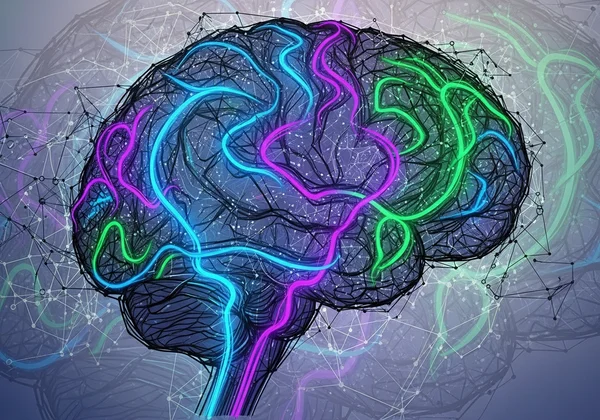
Difficulties with working memory can make it hard to remember instructions while reading a sentence or to keep track of characters and plot points in a story. This single weakness can therefore manifest as a symptom of both ADHD (forgetfulness) and dyslexia (poor reading comprehension). This neurological overlap explains why distinguishing between the two can be so challenging based on behavior alone.
How Comorbidity Affects Learning and Development
When a person has both ADHD and dyslexia, the challenges can compound. An individual might struggle to decode words due to dyslexia, while their ADHD makes it difficult to sustain the intense focus required to overcome that reading challenge. It creates a cycle where each condition makes the other harder to manage.
In a classroom or workplace, this might look like a student who reads slowly. They might also get distracted by noises outside the window. It might be an adult who avoids reading reports not just because it’s difficult, but because the task feels overwhelmingly boring and mentally draining. Recognizing this dual challenge is important. Effective strategies must address both language processing and attention regulation needs. A great first step is to start your test to see which symptoms are most prominent.
Recognizing ADHD vs. Dyslexia Symptoms in Daily Life
Untangling these two conditions requires looking closely at the reason behind a specific behavior. Is a child avoiding homework because the reading is too hard (dyslexia), or because they can’t sit still long enough to focus on it (ADHD)? Or is it both?
ADHD Symptoms That May Be Mistaken for Dyslexia
Certain ADHD-related behaviors can easily be misinterpreted as signs of a learning disability like dyslexia. It's important to look at the context and consistency of these actions.
Consider these common scenarios:
- Skipping words or lines while reading: A person with ADHD might do this because of impulsivity or a wandering focus, not because they can’t decode the words. They are rushing to get to the end.
- Poor reading comprehension: Someone with ADHD may understand the words perfectly but get distracted halfway through a page. They might start thinking about something else and forget what they just read, which isn't a language processing issue.
- Messy handwriting and spelling errors: These can result from rushing and impulsivity rather than a difficulty with the phonological rules of language. The person knows how to spell the word but makes a careless mistake.
Dyslexia Signs That Mimic ADHD Behaviors
Conversely, the intense effort required to manage dyslexia can produce behaviors that look just like ADHD. The mental fatigue from constantly decoding text can drain a person's cognitive resources.
Here are some examples:
- Appearing "inattentive" during reading tasks: A child or adult with dyslexia might stare out the window not because they are bored, but because they are mentally exhausted. Reading is a marathon for them, and they need frequent breaks.
- Fidgeting or seeming restless: The frustration and anxiety associated with reading difficulties can manifest as physical restlessness. It’s a coping mechanism for the stress of the task.
- Avoiding reading-heavy tasks: This can look like procrastination or a lack of motivation (common in ADHD), but the root cause may be the genuine difficulty and embarrassment associated with reading.
How Our ADHD Quiz Can Help Differentiate These Conditions
So, how can you begin to tell the difference? While a formal diagnosis requires a comprehensive evaluation by a professional, a well-designed screening tool can provide valuable initial clarity. It helps you organize your observations and identify patterns that point more strongly toward one condition or the other.
Questions That Screen for ADHD vs. Dyslexia
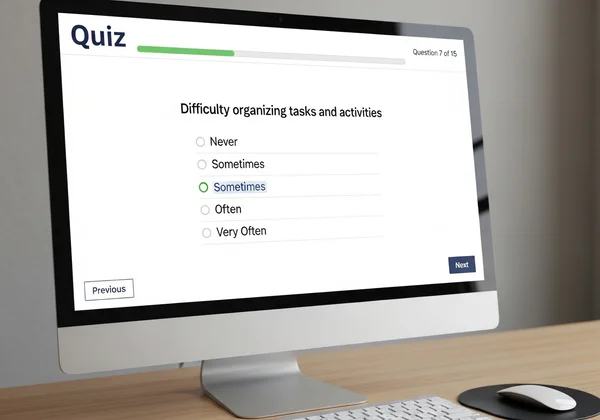
Our free online ADHD quiz is designed to focus on the core symptoms of ADHD as outlined in the DSM-5, the standard classification used by mental health professionals. While it is not a dyslexia test, its questions can help you see if your challenges are primarily related to attention regulation and executive function.
For example, the quiz will ask about:
- Your ability to organize tasks and activities.
- How often you lose things necessary for tasks.
- Whether you are easily distracted by external stimuli.
- Your tendency to fidget or feel restless.
If you score high on these questions but have fewer issues with reading mechanics, your challenges may be more aligned with ADHD. If your main struggles are with reading fluency, spelling, and decoding, but you have less trouble with organization and focus in non-reading activities, dyslexia might be the primary issue.
Interpreting Your Results: What Different Scores Mean
After completing the assessment, you will receive an instant summary of your responses. This summary highlights potential areas of concern related to inattention, hyperactivity, and impulsivity. It serves as a data point—a piece of information to help guide your journey.
A high score does not mean you have ADHD. It simply indicates that you are experiencing a significant number of symptoms commonly associated with the condition. You can use this result as a starting point for a conversation with a doctor or psychologist. Our optional AI-powered report can provide even deeper, personalized insights into your unique profile, but the first step is to get your initial results by taking the free ADHD quiz.
Taking the First Step Toward Clarity
When ADHD and dyslexia symptoms overlap, it can be confusing and frustrating to figure out what's really going on. But you don't need to remain uncertain about what you're experiencing. By understanding the core differences, observing symptoms in context, and using reliable tools, you can move toward clarity and find the right support.
Remember, ADHD is about challenges with regulating attention and impulse control, while dyslexia is about difficulties with language processing. Sometimes they exist together, creating a unique set of challenges. Recognizing the patterns in your own life is the most powerful first move you can make.
Ready to get some clarity on what you're experiencing? Our quiz can help you understand your symptoms better. Take the first step today. Our free, confidential, and science-based online ADHD quiz can provide you with the initial insights you need to confidently plan what comes next.

Frequently Asked Questions About ADHD and Dyslexia
Can you have both ADHD and dyslexia at the same time?
Yes, absolutely. This is known as comorbidity, and it is very common. Studies show that a significant percentage of people with ADHD also have dyslexia, and vice versa. When both are present, it's important to seek support that addresses both the attention-related challenges and the language-based learning difficulties.
How accurate is an online quiz for distinguishing ADHD from dyslexia?
An online quiz is a screening tool, not a diagnostic instrument. Our quiz is specifically designed based on DSM-5 criteria for ADHD. While it can't diagnose dyslexia, it can help you determine if your symptoms strongly align with those of ADHD. This information is a valuable starting point for a discussion with a healthcare professional, who can then conduct a full evaluation for one or both conditions.
What should I do if my quiz results suggest I might have ADHD or dyslexia?
If your results from our ADHD self-assessment quiz indicate potential ADHD traits, the recommended next step is to consult with a professional. This could be a primary care physician, a psychologist, or a psychiatrist. Bring your quiz results to the appointment to help guide the conversation. They can perform a comprehensive assessment to provide a formal diagnosis and discuss treatment options.
Are there specific treatments for ADHD-dyslexia comorbidity?
Yes. Treatment for co-occurring ADHD and dyslexia requires an integrated approach. This often involves strategies for managing ADHD symptoms (which may include behavioral therapy, coaching, or medication) combined with specialized educational instruction for dyslexia (such as structured literacy programs). The goal is to support both attention and learning simultaneously.